Biography
musician
Clarinettist (clarinet, bass clarinet), saxophonist (tenor, soprano), electronic performer, arranger, composer.
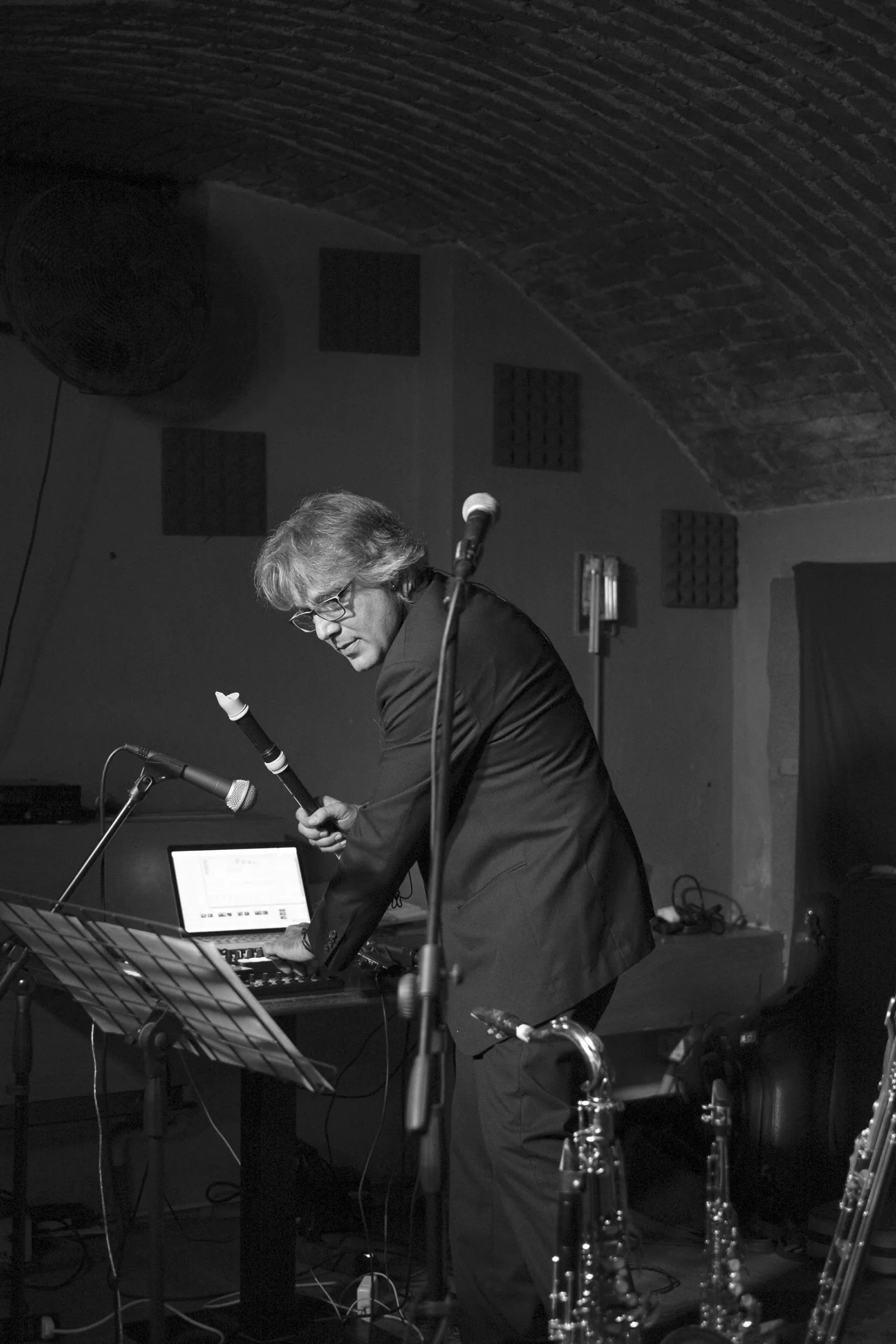
Born in Milan in 1964, Stefano Corradi started on violin at the Civica Scuola di Musica, but what he really wanted was the saxophone. At twelve he switched to clarinet; at sixteen he worked a whole summer to buy his first sax.
He studied with Primo Borali through his diploma at the Piacenza Conservatory, then with Antony Pay at the Accademia Lorenzo Perosi in Biella (International Academic Diploma), winning several competitions including the Città di Stresa International Competition.
Drawn to historical performance, he had a five-key boxwood clarinet and a basset clarinet built in London, a copy of the instrument Mozart wrote the K622 Concerto and K581 Quintet for. He studied 18th-century practice with Pierre-André Taillard in Basel and performed K622 as soloist at the Varese International Early Music Festival.
A lifelong student of jazz, he taught in Milan schools until 2000, when he left to tour Italy’s major theatres for nearly five years with Moni Ovadia, as performer and arranger. In 2006 he co-founded the Orchestra di via Padova, a multi-ethnic ensemble he chaired until 2011.
His own works include Milano, ritagli di tempo (SCQuartètt), Pierino e il bruco for narrator and multicultural orchestra (premiered in 2013 at the Milan Conservatory’s Sala Verdi with Claudio Bisio), Don Quixote with the Matheric Quartet (Da Vinci Jazz) and Klezmer a Paris with Xilo Ensemble.
His work with electronics, from solo live sets to real-time scoring of films and images, now continues in Modern Clarinet Horizon, a series he composes, performs and produces entirely himself. He also leads music-based corporate training, teaches clarinet, saxophone, harmony and improvisation, and created MEG – Music Exercises Generator, an app for practising scales, chord progressions and jazz standards.